
A Subject in Regenerative Farming Not Discussed
posted on
July 14, 2026
There are two struggles in regenerative farming.
One is visible. The other is hidden.
The visible struggle is obvious. Small farms like ours compete against companies with enormous marketing budgets, national distribution, investor backing, and public relations teams. A company like Vital Farms has a market capitalization measured in billions of dollars. They buy placement in grocery stores across the country, dominate advertising channels, and repeat carefully crafted messages nationally until they become accepted as truth.
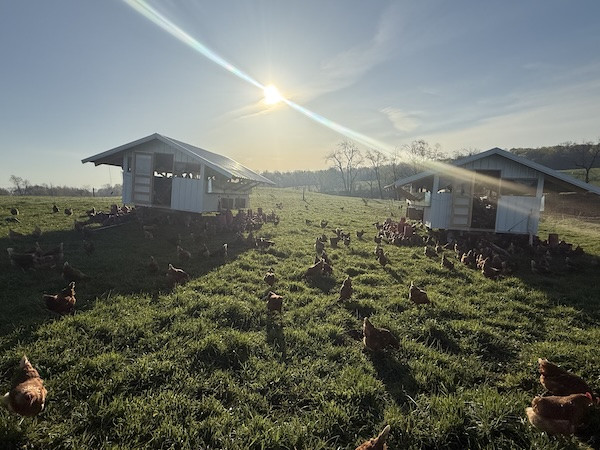
For years, terms like "pasture-raised" have been used because chickens were actually being raised in green, abundant pastures. Corporations like Vital Farms practice something entirely different. These details matter. Definitions matter. Transparency matters. Yet large companies have enormous resources to shape public perception.
That is the visible fight. It's the proverbial “David versus Goliath” story everyone recognizes.
The hidden struggle, however, is far more important.
Farming is heavily dependent on debt. Equipment, land, livestock and operation loans. Production seasons are financed and insured. Interest and insurance payments become significant cost centers. These payment schedules create a difficult reality - many farms spend a significant portion of their energy servicing financial obligations.
Farming becomes less and less about stewarding land and animals and more about generating enough cash flow to satisfy lenders. This pressure, without doubt, changes behavior. It changes the way decisions are made and what priorities are highest. When debt becomes large enough, nearly everything becomes secondary to the repayment schedule.
Erin and I recognized this hard reality early on. We decided that if we were serious about building a truly regenerative farm, it needed to be a financially regenerative farm as well. That meant refusing to finance our operations.
No investors. No shareholders. No operating loans. No one sits at a table across from us explaining why we should relax our standards to improve profitability or efficiency.

To be clear - this decision has never been easy. Every year, peak production season is May through October, and we barely scrape by. We’ve nearly lost everything – several times.
In many obvious ways, it has made our journey significantly harder. Growth is slower when you don't borrow your way forward. Infrastructure takes longer to build. New projects take patience. Expansion happens only when the resources actually exist.
But there is a tradeoff that we found to be worth everything.
Freedom.
Freedom to tell the truth. Freedom to make decisions that align with our mission rather than someone else's financial model. Freedom to reject shortcuts. Freedom to say no.
Investing in soil biology, grazing systems, animal welfare, local processing, and employees in alignment with our mission takes years.
We remain free to serve the people who matter most.
Our patrons.
That is our secret weapon.
Not marketing. Not venture capital. Not investor funding.
Our patrons.
Our relationship with our patrons remains rock solid because they provide the financial freedom for us to pursue our mission without distraction.
Every food dollar entrusted to our care directly funds the farm itself. Food money pays to keep our mission going and growing, not servicing debt.
Our patrons have become our shareholders. They may not own a piece of the business, but they make the business possible. Their support allows us to remain financially independent. We realized a valuable truth early -- the relationship between our farm and our patrons forms the symbiotic financial backbone of truly regenerative farming.
As we invest in better stewardship, our patrons receive better food. As our patrons continued supporting the farm, we can invest in the resources to become better stewards. We strengthen one another. The cycle continues. It’s regenerative finance serving regenerative farming.
This relationship has created something highly resilient. A farm that answers to no investors. No shareholders. No bankers. We are free to serve our mission and the One who has called us forward into discovering the riches of a food production design centered on healing rather than exploitation.
A special thank you to all of our patrons who make this possible. ❤️🙏 Dustin and Erin


 Facebook